PeeVPee damage players: Combat and Scoring Guide
Learn how PeeVPee player damage, knockback, point stealing, and drink effects connect, with practical combat tips and confirmed details.
How PeeVPee Turns Player Damage Into a Scoring Threat
Your next attack in PeeVPee could do more than disrupt a friend—it could help swing the score. If you’re searching for PeeVPee damage players, the important detail is that combat includes damaging opponents, knocking them around, and stealing their points. This PeeVPee damage players guide explains those confirmed mechanics, why they matter alongside territory claiming, and what to test before committing to a fight.
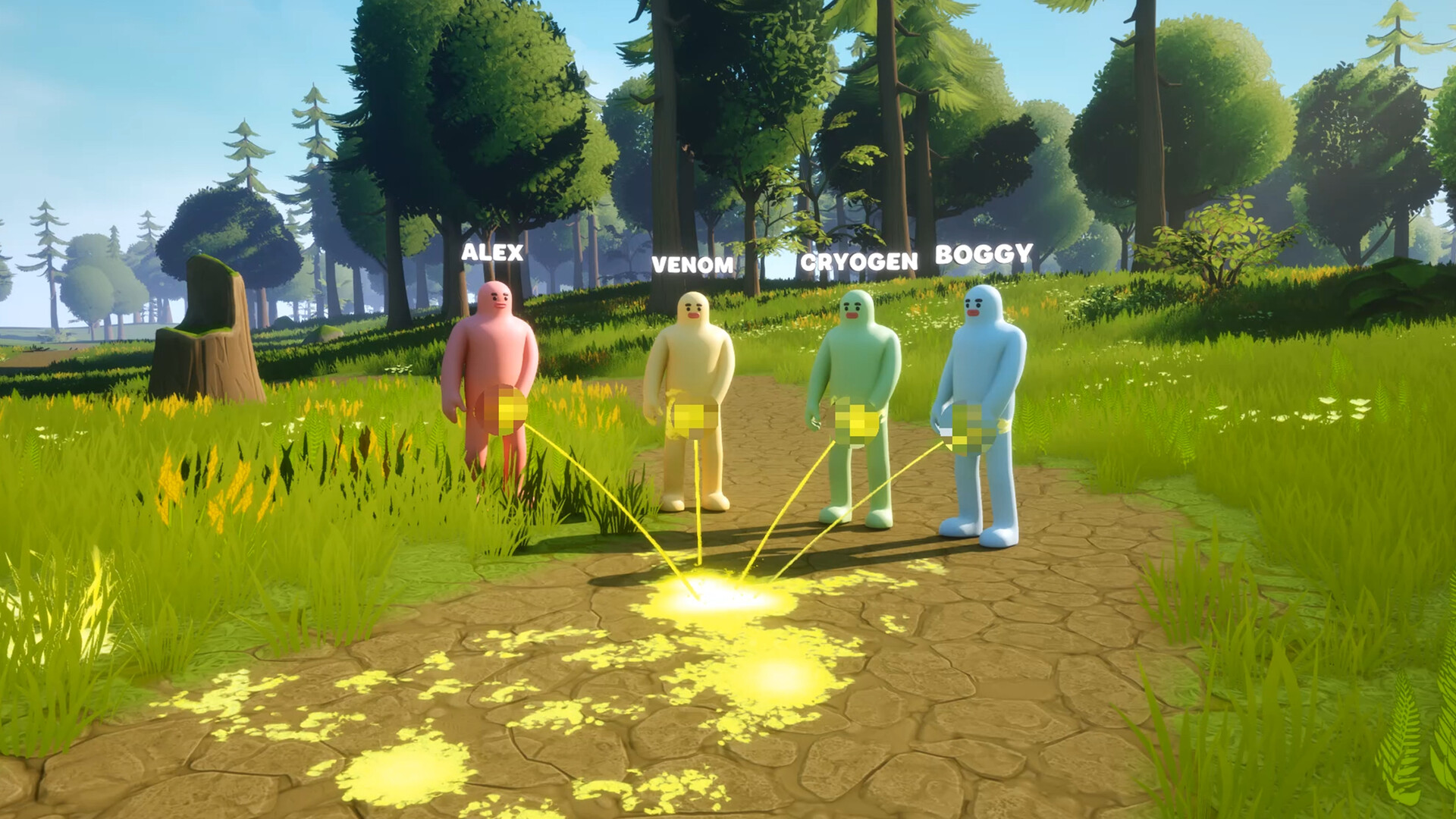
Official screenshot · Source: Steam store
PeeVPee is a multiplayer party game built around drinking, filling your bladder, and using that supply to cause trouble. Spraying objects claims them for points, while attacking other players introduces a competing use for your resources.
That creates the central combat question: Should you spend your available supply scoring on the map or interfering with an opponent?
The official PeeVPee Steam listing confirms the broad mechanics discussed here. As of November 6, 2026, the game is listed as coming soon, with a November 9 release date. A free demo is available. The advice below separates confirmed features from suggested experiments; it does not assume unpublished damage values or scoring formulas.
| Mechanic | Confirmed information | Why it matters |
|---|---|---|
| Drinking | Drinks fill your bladder | Refilling supports your ability to act |
| Object claiming | Spraying objects claims them and scores points | Direct combat is not the only scoring route |
| Player damage | You can damage opponents | Other players are valid combat targets |
| Knockback | Players can be knocked around | Positioning can matter alongside damage |
| Point stealing | Combat includes stealing opponents’ points | An encounter can affect the scoreboard |
| Drink effects | Drinks can change your spray’s effects | Your current drink can influence your approach |
The store description does not explain exactly how these outcomes connect. In particular, it does not establish whether every hit steals points, how much damage attacks deal, or what triggers a point transfer.
PeeVPee Damage Players: What Combat Actually Confirms
The clearest answer to the PeeVPee damage players query is straightforward: yes, attacking other players is an advertised part of the game. It is not just a territory-painting contest where everyone works around one another.
However, the available information describes combat outcomes rather than a complete combat system. That distinction matters when deciding what advice to trust.
Damage, displacement, and stolen points are separate outcomes
Treat these as three things to observe rather than one guaranteed result from every attack:
- Damage: An attack hurts another player.
- Displacement: An effect moves or pushes another player.
- Point stealing: An interaction transfers points away from an opponent.
The official description mentions all three, but it does not publish their individual triggers. You should not assume that dealing damage automatically produces a fixed point reward.
Similarly, knockback is not proof of a stun, interruption, or elimination. Those additional mechanics are not established by the supplied information.
Build your first fights around a question
Instead of entering every encounter hoping for the best, choose one thing to learn. For example, observe whether your current spray visibly pushes an opponent, then check whether the scoreboard changes during that encounter.
This approach makes even an unsuccessful exchange useful. You are gathering information that can improve your next decision.
| Question to test | What to observe | What not to assume |
|---|---|---|
| Does this attack damage a player? | Any visible damage feedback the game provides | A specific damage number |
| Does this effect cause knockback? | Whether the target changes position | That movement also prevents actions |
| When are points stolen? | Score changes during an isolated encounter | That every hit transfers points |
| How much supply does fighting use? | Your available supply before and after | A fixed attack cost |
| Can this effect influence nearby objects? | Changes to objects during the exchange | That all effects behave identically |
For cleaner observations, change one variable at a time. If you switch drinks, targets, and locations together, it becomes harder to tell what caused the result.
Choosing Between Attacking Players and Claiming Objects
A useful PeeVPee damage players strategy starts with the scoreboard, not just the nearest opponent. Because object claiming and player combat both contribute to the contest, chasing someone is not automatically better than scoring nearby.
The key is opportunity cost: time and supply spent pursuing a rival are resources you are not spending on objects.
Give every fight a purpose
Before engaging, identify your intended result:
- Damage an opponent to learn how your current effect behaves.
- Push a rival away from an area you want to use.
- Test the point-stealing mechanic in a controlled exchange.
- Contest an object rather than surrendering it without resistance.
These are suggested objectives, not promises that a particular tactic will succeed. Their value is that they give you a reason to stop fighting when the encounter no longer serves your goal.
For example, suppose another player moves away while several claimable objects remain nearby. Continuing the chase might be entertaining, but taking those objects is an alternative worth evaluating.
| Situation | Suggested decision | Reasoning |
|---|---|---|
| Nearby objects are available and uncontested | Consider claiming them first | Object claiming is a confirmed scoring method |
| An opponent is contesting the same area | Evaluate a short engagement | Combat may help change the local situation |
| A rival keeps moving away | Reconsider the pursuit | Travel can delay other scoring opportunities |
| You have little supply remaining | Look for a chance to refill | Both combat and claiming depend on your bladder |
| You just acquired an unfamiliar effect | Test it deliberately | Learning its behavior can improve later choices |
Compare results instead of counting hits
A busy fight can feel productive without improving your position. After an exchange, ask:
- Did my score change?
- Did the opponent’s score change?
- Did I gain a useful position?
- What could I have claimed instead?
You do not need a published damage formula to make this comparison. The aim is to identify whether your decisions are producing useful outcomes under the rules you can observe.
Using Drinks, Knockback, and Positioning Deliberately
The PeeVPee damage players loop is not limited to finding a target and holding an attack. The game also advertises drink-dependent effects, including setting things on fire, pushing players, and changing colors.
That confirms variety, but not a complete drink roster. No supplied source identifies specific drink names, effect durations, damage multipliers, or an optimal combination.
Learn effects before assigning them a role
A fire-related effect might tempt you to assume lingering damage. A pushing effect might suggest environmental eliminations. Neither conclusion is confirmed by the available description.
Start with what you can observe instead.
| Advertised effect | Useful test | Unconfirmed detail |
|---|---|---|
| Setting things on fire | Observe what ignites and what happens afterward | Duration and any damage behavior |
| Pushing players | Watch the direction and extent of movement | Force, resistance, and secondary consequences |
| Changing colors | Check what changes visually | Whether the change has a scoring function |
| Other drink-dependent effects | Compare behavior after changing drinks | The full effect list and combinations |
Use positioning as an objective
Knockback gives you a reason to think about where an opponent stands, not merely whether you can hit them. A practical experiment is to approach a contested area, apply a pushing effect, and observe whether the displacement gives you room to claim an object.
That is a testable tactical idea, not a verified winning sequence. Its success depends on details the store description does not provide.
Also watch your own position. If an exchange carries you away from available objects and drinks, reassess whether it remains worthwhile.
Keep resource decisions simple
Your bladder is the game’s advertised ammunition supply. The exact capacity, depletion rate, and refill timing are not published in the reference material.
Until you learn those values through play, use a basic routine: check your supply before engaging, watch how quickly the encounter consumes it, and reconsider the fight when your options narrow.
A Practical Demo Plan for Learning Combat
The fastest way to make a PeeVPee damage players guide useful is to turn its unknowns into a short practice plan. The free demo offers an opportunity to investigate the mechanics firsthand, although the available description does not establish whether every planned launch feature appears there.
Treat your observations as demo findings rather than permanent rules for the final release.
Start with a baseline
First, learn the basic loop without trying to optimize it:
- Find a drink and observe how refilling works.
- Spray an object and watch how claiming affects your score.
- Attack a player and look for damage or movement feedback.
- Compare your supply before and after each action.
- Repeat with another drink when available.
Separating these actions makes their effects easier to understand. A chaotic encounter involving multiple players may be fun, but it is a poor first test of a scoring rule.
Keep a small combat notebook
You only need a few observations to begin making better choices:
- Current effect: What visibly changed after drinking?
- Target response: Did the opponent move or show damage feedback?
- Score result: Did either score change?
- Resource result: How much supply appeared to be used?
- Alternative action: Were nearby objects available to claim?
Record uncertainty honestly. “The score changed during the fight” is more reliable than concluding that each hit stole points when several actions happened together.
Compare encounters with object claiming
Once you understand the basics, alternate between short combat-focused attempts and object-focused play. Compare the results you actually achieve rather than assuming one approach is universally stronger.
For your own PeeVPee damage players strategy, the most useful benchmark is not a speculative damage ranking. It is whether fighting improves your scoring opportunities enough to justify the resources and attention it requires.
There is no confirmed best drink, guaranteed combo, or universal attack priority in the supplied sources. A measured testing routine will serve you better than invented precision.
FAQ
Can you damage other players in PeeVPee?
Yes. The official description confirms player damage, knockback, and point stealing. If you searched PeeVPee damage players, those are the core advertised combat features. Exact damage values and the relationship between those outcomes are not published in the supplied material.
Does every successful attack steal points?
That is not confirmed. The store listing advertises stealing opponents’ points but does not explain the trigger, amount, or frequency. Observe scoreboard changes during controlled encounters before treating point stealing as an automatic result of each hit.
Which drink deals the most damage?
There is not enough official information to name a highest-damage drink. Drinks can modify effects, but the supplied material contains no drink table or damage statistics. Test each available effect and keep damage observations separate from knockback or cosmetic changes.
Can I try PeeVPee before its full release?
Yes, a free Steam demo is available. As of November 6, 2026, the full game is listed as coming soon for Windows and Linux, with a November 9 release date. Use the demo to learn the core loop, while recognizing that demo observations may not establish final-release behavior.
Related Guides
PeeVPee knock them around: Combat and Scoring Guide
Learn what PeeVPee confirms about knockback, drink effects, and point stealing, plus practical combat tests to try in the free Steam demo.
PeeVPee pee on your friends: Combat Guide
Learn how PeeVPee combat, territory scoring, and drink effects work, with practical demo tips and confirmed release details.
PeeVPee push players around: Combat Guide
Learn what PeeVPee confirms about pushing players, how drinks affect combat, and what to test in the demo before building a knockback strategy.
PeeVPee fill your bladder: Drinking and Scoring Guide
Learn how to fill your bladder in PeeVPee, use drinks for combat and scoring, and practice the basics with this source-backed beginner guide.
PeeVPee pee on everything: Scoring Guide and Tips
Understand PeeVPee's object claiming, point stealing, and drink effects, with practical scoring tips and a checklist for testing the free demo.